C-type lectins show Ca-dependent binding of specific glycan determinants, expressed by many helminth species (Loukas & Maizels, 2000, Bauters et al, 2017). They are especially prominent in the ES of Toxocara canis infective larvae, with major secreted proteins TES-32 (Loukas et al., 1999) and TES-70 (Loukas et al., 2000). Both have acquired additional domains of the ShK family.
C.elegans has a total of 283 clec genes, some of which have been implicated in antibacterial resistance (Pees et al 2021). C-type lectins are also involved in plant nematode-host interactions (Zhao et al, 2021 and Ning et al, 2022), and have also been reported in the nonparasitic marine nematode Laxus oneistus (Bulgheresi et al 2009).
Modelling of the C-Type Lectin domain of TES-32/CTL-1 shows close conservation of structure compared to mammalian mannose binding protein MBP-1 (Loukas et al., 1999).

Both Heligmosomoides polygyrus and Nippostrongylus brasiliensis secrete C-type lectins, as described by Harcus et al (2009), with the accompanying phylogenetic tree: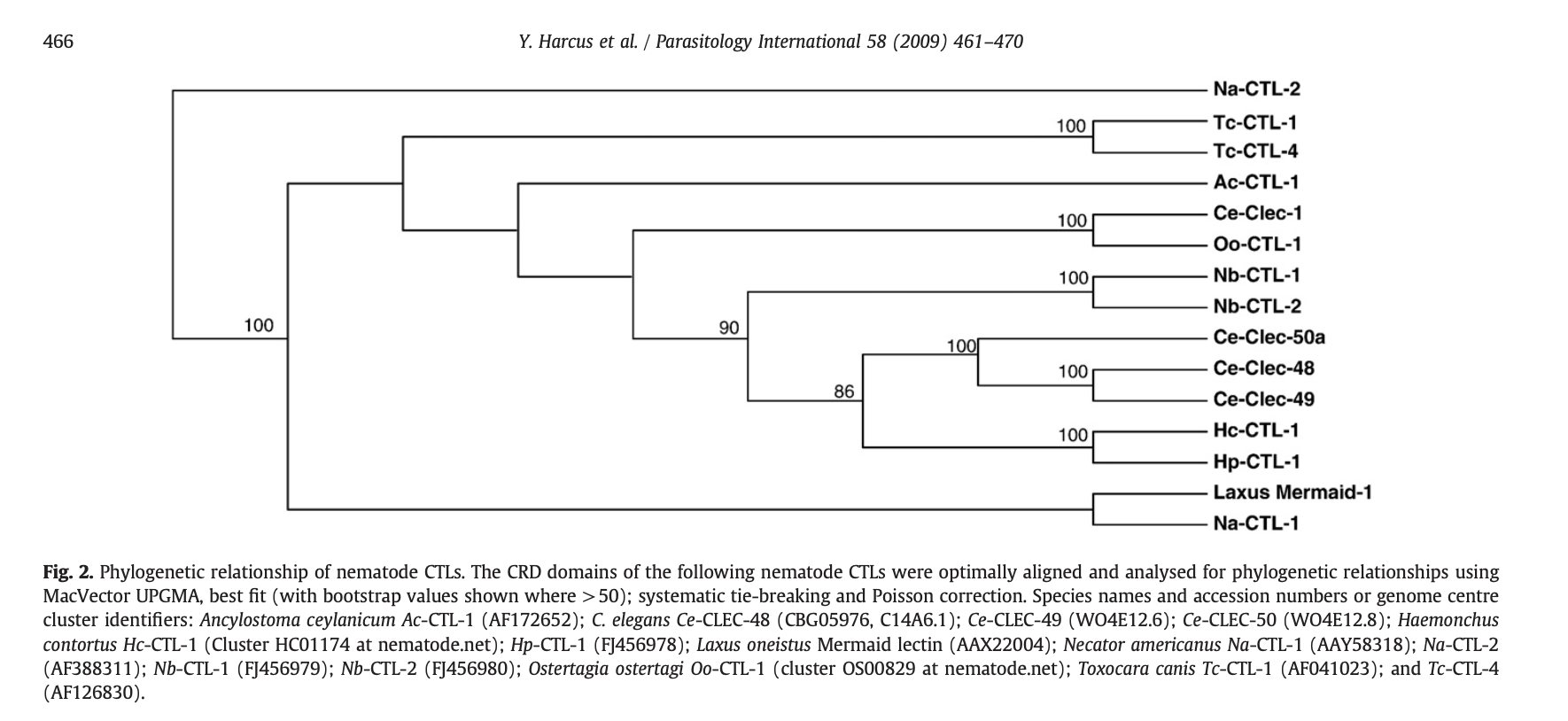
Harcus et al. also reported that antibodies to H. polygyrus CTL-1 bind to the cuticle surface of adult worms (see below).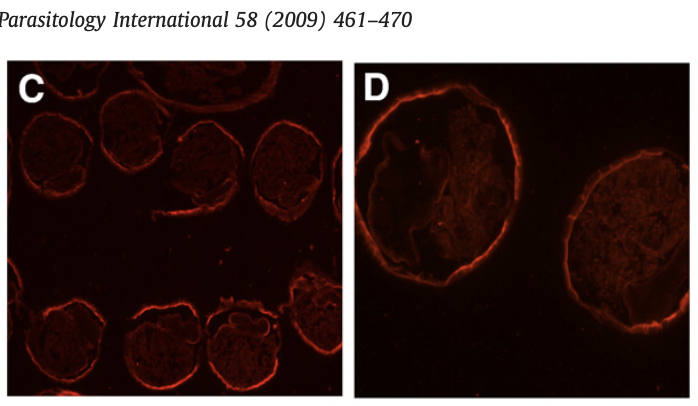
References
Bauters, L., Naalden, D. and Gheysen, G. (2017). The distribution of lectins across the phylum nematoda: a genome-wide search. Int J Mol Sci 18(1). PDF
Bulgheresi, S., Schabussova, I., Chen, T., Mullin, N.P., Maizels, R.M. and Ott, J.A. (2006). A new C-type lectin similar to the human immunoreceptor DC-SIGN mediates symbiont acquisition by a marine nematode. Applied and Environmental Microbiology 72: 2950-2956. PDF
Harcus, Y., Nicoll, G., Murray, J., Filbey, K., Gomez-Escobar, N. and Maizels, R.M. (2009). C-type lectins from the nematode parasites Heligmosomoides polygyrus and Nippostrongylus brasiliensis. Parasitol Int 58: 461-470. PDF
Loukas, A. and Maizels, R.M. (2000). Helminth C-type lectins and host-parasite interactions. Parasitol Today 16(8): 333-339. doi: 10.1016/s0169-4758(00)01704-x. PDF.
Loukas, A.C., Mullin, N.P., Tetteh, K.K.A., Moens, L. and Maizels, R.M. (1999). A novel C-type lectin secreted by a tissue-dwelling parasitic nematode. Current Biology 9: 825-828. PDF
Loukas, A.C., Doedens, A., Hintz, M. and Maizels, R.M. (2000). Identification of a new C-type lectin, TES-70, secreted by infective larvae of Toxocara canis , which binds to host ligands. Parasitology 121: 545-554. PDF
Ning, J., Zhou, J., Wang, H., Liu, Y., Ahmad, F., Feng, X., Fu, Y., Gu, X. and Zhao, L. (2022). Parallel evolution of C-type lectin domain gene family sizes in insect-vectored nematodes. Front Plant Sci 13: 856826. PMC9085898 PDF
Pees, B., Yang, W., Kloock, A., Petersen, C., Peters, L., Fan, L., Friedrichsen, M., Butze, S., Zarate-Potes, A., Schulenburg, H. and Dierking, K. (2021). Effector and regulator: Diverse functions of C. elegans C-type lectin-like domain proteins. PLoS Pathog 17(4): e1009454. PMC8051790 10.1371/journal.ppat.1009454.
Zhao, J., Sun, Q., Quentin, M., Ling, J., Abad, P., Zhang, X., Li, Y., Yang, Y., Favery, B., Mao, Z. and Xie, B. (2021). A Meloidogyne incognita C-type lectin effector targets plant catalases to promote parasitism. New Phytol 232(5): 2124-2137. 10.1111/nph.17690. PDF.