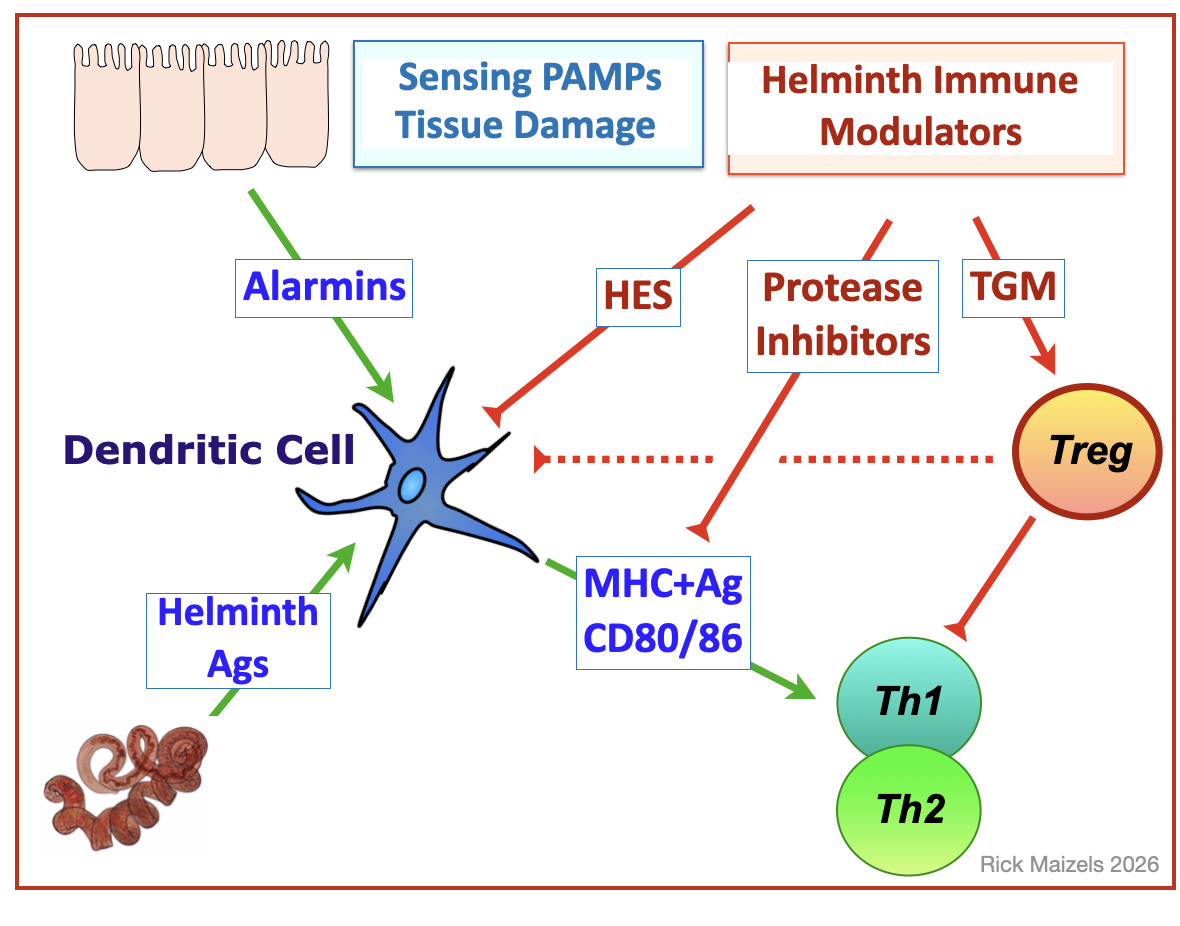
Dendritic cells (DCs) are crucial antigen-presenting cells which initiate the immune response to infection. The following is taken from our most recent publication, Kemter et al (2026).
*****************************************
The role of DCs in driving immune responses to helminths is well-documented (Maizels et al, 2018), but of equal importance is the ability of parasites and their products to interfere with DC function or to redirect it towards a tolerogenic phenotype that promotes Tregs.
Across a broad range of helminth parasites, a frequent observation is inhibition of TLR ligand-induced DC activation (Kemter et al., 2026). We observed this originally with excretory-secretory products of Nippostrongylus brasiliensis (NES) that selectively block IL-12 production in response to LPS (Balic et al., 2004). Downstream of TLR signalling, components of the trematode Fasciola hepatica inhibit activation of the NF-κB subunit p65 (Hamilton et al , 2009) as well as MAPKs (Vukman et al , 2013).
Omega-1, a ribonuclease responsible for some of the immune modulatory effects of the soluble egg antigens from Schistosoma mansoni (SEA) inhibits LPS-induced upregulation of CD86 and production of IL-12p70 by human monocyte derived DCs (moDCs). Omega-1 function is dependent on both its glycosylation and its activity as an RNase, as it is bound and internalized by the mannose receptor on moDC and subsequently non-specifically degrades both rRNA and mRNA, effectively inhibiting protein synthesis by DCs (Everts et al., 2009; Steinfelder et al., 2009; Everts et al., 2012).
ES-62 is a phosphorylcholine-bearing excretory/secretory (ES) product of the filarial nematode Acanthocheilonema viteae(Goodridge et al., 2014), which sequesters the MyD88 signalling protein (Ball et al., 2018) and induces autophagic degradation of key components of LPS-induced pathways (Eason et al., 2016). The ES of Trichuris suis can inhibit signalling pathways downstream of TLR4, as well as actively reduce the expression levels of TLR4 itself (Klaver et al. 2015).
Resulting from direct helminth interference with DC function, bystander responses may also be attenuated as in the case of ovalbumin-induced airway allergic inflammation (Patente et al, 2024).
Our own studies on modulation of DCs by Heligmosomoides polygyrus and its products are detailed here. To summarise work from a number of laboratories, DCs from infected mice are less responsive to TLR ligands and induce poorer responses in vivo compared to normal DCs (Segura et al. 2007), while specific subsets that expand during infection favour Treg induction (Smith et al., 2011, Li et al. 2011, Andrusiate et al., 2026). Functionally, transfer of DCs from H. polygyrus-infected mice to recipient animals protect them from inflammatory colitis (Blum et al 2012) but undermine immunity to Citrobacter infection (Chen et al 2006). The molecular pathway of DC modulation can be reproduced by parasite secretions (HES) which show interference with late-phase (post-8 hour) TLR responses, most marked on production of IL-12, and can be attributed to a single protein fraction of HES (Kemter et al., 2026)..
References
Andrusaite A, Ridgewell O, Ahlback A, Webster H, Yamaguchi H, Peel M, et al. Intestinal helminth skews DC2 development towards regulatory phenotype to counter the anti-helminth immune response. BioRχiv. 2025. https://doi.org/10.1101/2024.1109.1111.612410
Balic A, Harcus Y, Holland MJ, Maizels RM. Selective maturation of dendritic cells by Nippostrongylus brasiliensis-secreted proteins drives Th2 immune responses. Eur J Immunol. 2004;34(11):3047–59. https://doi.org/10.1002/eji.200425167 PMID: 15468056
Ball DH, Al-Riyami L, Harnett W, Harnett MM. IL-33/ST2 signalling and crosstalk with FcεRI and TLR4 is targeted by the parasitic worm product, ES-62. Sci Rep. 2018;8(1):4497. https://doi.org/10.1038/s41598-018-22716-9 PMID: 29540770
Blum AM, Hang L, Setiawan T, Urban JP Jr, Stoyanoff KM, Leung J, et al. Heligmosomoides polygyrus bakeri induces tolerogenic dendritic cells that block colitis and prevent antigen-specific gut T cell responses. J Immunol. 2012;189(5):2512–20. https://doi.org/10.4049/jimmunol.1102892 PMID: 22844110
Chen C-C, Louie S, McCormick BA, Walker WA, Shi HN. Helminth-primed dendritic cells alter the host response to enteric bacterial infection. J Immunol. 2006;176(1):472–83. https://doi.org/10.4049/jimmunol.176.1.472 PMID: 16365440
Eason RJ, Bell KS, Marshall FA, Rodgers DT, Pineda MA, Steiger CN, et al. The helminth product, ES-62 modulates dendritic cell responses by inducing the selective autophagolysosomal degradation of TLR-transducers, as exemplified by PKCδ. Sci Rep. 2016;6:37276. https://doi.org/10.1038/srep37276 PMID: 27869138
Everts B, Perona-Wright G, Smits HH, Hokke CH, van der Ham AJ, Fitzsimmons CM, et al. Omega-1, a glycoprotein secreted by Schistosoma mansoni eggs, drives Th2 responses. J Exp Med. 2009;206(8):1673–80. https://doi.org/10.1084/jem.20082460 PMID: 19635864
Everts B, Hussaarts L, Driessen NN, Meevissen MHJ, Schramm G, van der Ham AJ, et al. Schistosome-derived omega-1 drives Th2 polarization by suppressing protein synthesis following internalization by the mannose receptor. J Exp Med. 2012;209(10):1753–67, S1. https://doi.org/10.1084/jem.20111381 PMID: 22966004
Goodridge HS, Marshall FA, Wilson EH, Houston KM, Liew FY, Harnett MM, et al. In vivo exposure of murine dendritic cell and macrophage bone marrow progenitors to the phosphorylcholine-containing filarial nematode glycoprotein ES-62 polarizes their differentiation to an anti-inflammatory phenotype. Immunology. 2004;113(4):491–8. https://doi.org/10.1111/j.1365-2567.2004.01993.x PMID: 15554927
Hamilton CM, Dowling DJ, Loscher CE, Morphew RM, Brophy PM, O’Neill SM. The Fasciola hepatica tegumental antigen suppresses dendritic cell maturation and function. Infect Immun. 2009;77:2488–98.
Kemter AM, Grainger JR, Smyth DJ,, Forss C, Phythian-Adams A, White RF, et al. (2026) Curtailment of Toll-like receptor signalling and cytokine production in dendritic cells by secreted products of Heligmosomoides polygyrus. PLoS Pathog 22(8): e1014528. https://doi.org/10.1371/journal.ppat.1014528
Klaver EJ, van der Pouw Kraan TCTM, Laan LC, Kringel H, Cummings RD, Bouma G, et al. Trichuris suis soluble products induce Rab7b expression and limit TLR4 responses in human dendritic cells. Genes Immun. 2015;16(6):378–87. https://doi.org/10.1038/gene.2015.18 PMID: 25996526
Li Z, Liu G, Chen Y, Liu Y, Liu B, Su Z. The phenotype and function of naturally existing regulatory dendritic cells in nematode-infected mice. Int J Parasitol. 2011;41:1129–37.
Maizels RM, Smits HH, McSorley HJ. Modulation of host immunity by helminths: the expanding repertoire of parasite effector molecules. Immunity. 2018;49(5):801–18. https://doi.org/10.1016/j.immuni.2018.10.016 PMID: 30462997
Patente TA, Gasan TA, Scheenstra M, Ozir-Fazalalikhan A, Obieglo K, Schetters S, et al. S. mansoni -derived omega-1 prevents OVA-specific allergic airway inflammation via hampering of cDC2 migration. PLoS Pathog. 2024;20(8):e1012457. https://doi.org/10.1371/journal.ppat.1012457 PMID: 39186814
Segura M, Su Z, Piccirillo C, Stevenson MM. Impairment of dendritic cell function by excretory-secretory products: a potential mechanism for nematode-induced immunosuppression. Eur J Immunol. 2007;37(7):1887–904. https://doi.org/10.1002/eji.200636553 PMID: 17563917
Smith KA, Hochweller K, Hämmerling GJ, Boon L, Macdonald AS, Maizels RM. Chronic helminth infection mediates tolerance in vivo through dominance of CD11clo CD103– DC population. J Immunol. 2011;186:7098–109. https://doi.org/10.4049/jimmunol.1003636
Steinfelder S, Andersen JF, Cannons JL, Feng CG, Joshi M, Dwyer D, et al. The major component in schistosome eggs responsible for conditioning dendritic cells for Th2 polarization is a T2 ribonuclease (omega-1). J Exp Med. 2009;206(8):1681–90. https://doi.org/10.1084/jem.20082462 PMID: 19635859
Vukman KV, Adams PN, O’Neill SM. Fasciola hepatica tegumental coat antigen suppresses MAPK signalling in dendritic cells and up-regulates the expression of SOCS3. Parasite Immunology. 2013;35:234–8.
Maizels Lab Publications on DCs in Helminth Infections
Dendritic cell phenotypes in H polygyrus infection
Smith, K.A., Hochweller, K., Hämmerling, G.J., Boon, L., Macdonald, A.S. and Maizels, R.M. (2011). Chronic helminth infection mediates tolerance in vivo through dominance of CD11clo CD103– DC population. J Immunol 186: 7098-7109. PMC4794626.
Dendritic cell conditioning by Nippostrongylus brasiliensis:
Balic, A., Harcus, Y., Holland, M.J. and Maizels, R.M. (2004). Selective maturation of dendritic cells by Nippostrongylus brasiliensis secreted proteins drives T helper type 2 immune responses. European Journal of Immunology 34: 3047-3059.
Balic A, Smith KA, Harcus Y, Maizels RM. (2009) Dynamics of CD11c+ dendritic cell subsets in lymph nodes draining the site of intestinal nematode infection. Immunol Lett. 2009;127:68-75. doi: 10.1016/j.imlet.2009.09.001Mai