Cystatins are cysteine protease inhibitors (CPIs), a major gene family across all parasitic organisms (Gregory et al., 2008; Klotz et al, 2011) and prominent in many helminths. The Maizels Lab studied the two cystatins of the filarial parasite Brugia malayi.
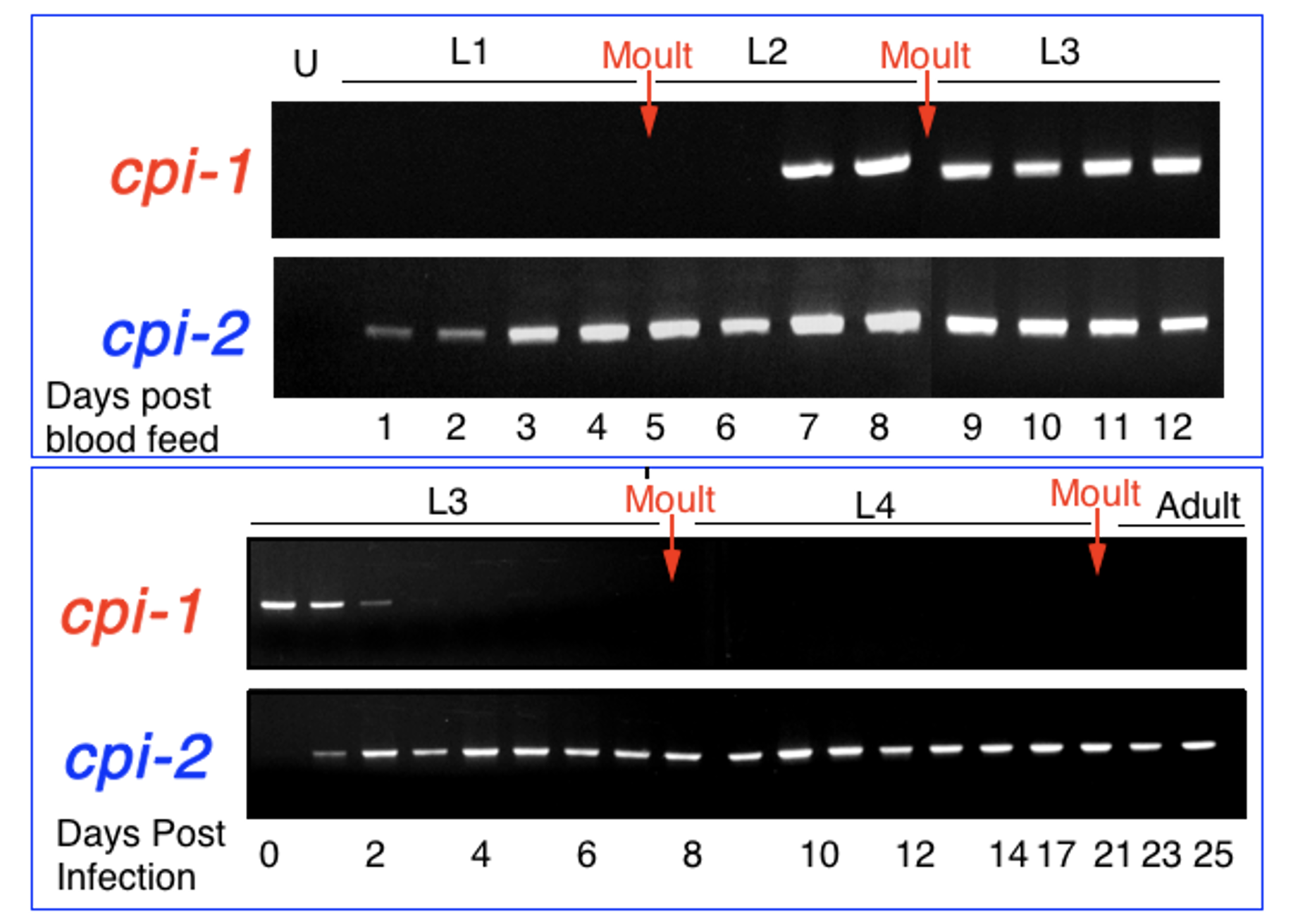
In Brugia malayi. Bm-CPI-1 is expressed only in the mosquito stage (upper panel), and Bm-CPI-2 throughout the life cycle (including mammalian stages, lower panel (Figure from Bill Gregory).
Further data on the surface expression of CPI-1 (on L3) and CPI-2 (on adults) are presented on the “Unpublished Data” page.
Bm-CPI-2 blocks antigen processing by inhibiting Asparaginyl EndoPeptidase (AEP) in antigen presenting cells (Manoury et al., 2001 ), through a second inhibitory site that comprises the SND motif (Murray et al., 2005).
Notably, B. malayi CPI-2 is a bifunctional inhibitor with two active sites, as also found in related filarial products such as Onchocystatin (Ov-CPI-2, Schönemeyer et al., 2001),


References
Klotz, C., Ziegler, T., Danilowicz-Luebert, E. and Hartmann, S. (2011). Cystatins of parasitic organisms. Adv Exp Med Biol 712: 208-221. Web link
Manoury, B., Gregory, W.F., Maizels, R.M. and Watts, C. (2001). Bm-CPI-2, a cystatin homolog secreted by the filarial parasite Brugia malayi, inhibits class II MHC-restricted antigen processing. Current Biology 11: 447-451. PDF
Gregory, W.F. and Maizels, R.M. (2008). Cystatins from filarial parasites: evolution, adaptation and function in the host-parasite relationship. International Journal of Biochemistry & Cell Biology 40: 1389-1398. PDF
Murray, J., Manoury, B., Balic, A., Watts, C. and Maizels, R.M. (2005). Bm-CPI-2, a cystatin from Brugia malayi nematode parasites, differs from C.elegans cystatins in a specific site mediating inhibition of the antigen-processing enzyme AEP. Molecular and Biochemical Parasitology 139: 197-203. PDF
Schönemeyer, A., Lucius, R., Sonnenburg, B., Brattig, N., Sabat, R., Schilling, K., Bradley, J. and Hartmann, S. (2001). Modulation of human T cell responses and macrophage functions by onchocystatin, a secreted protein of the filarial nematode Onchocerca volvulus. Journal of Immunology 167 : 3207-3215 Web link.