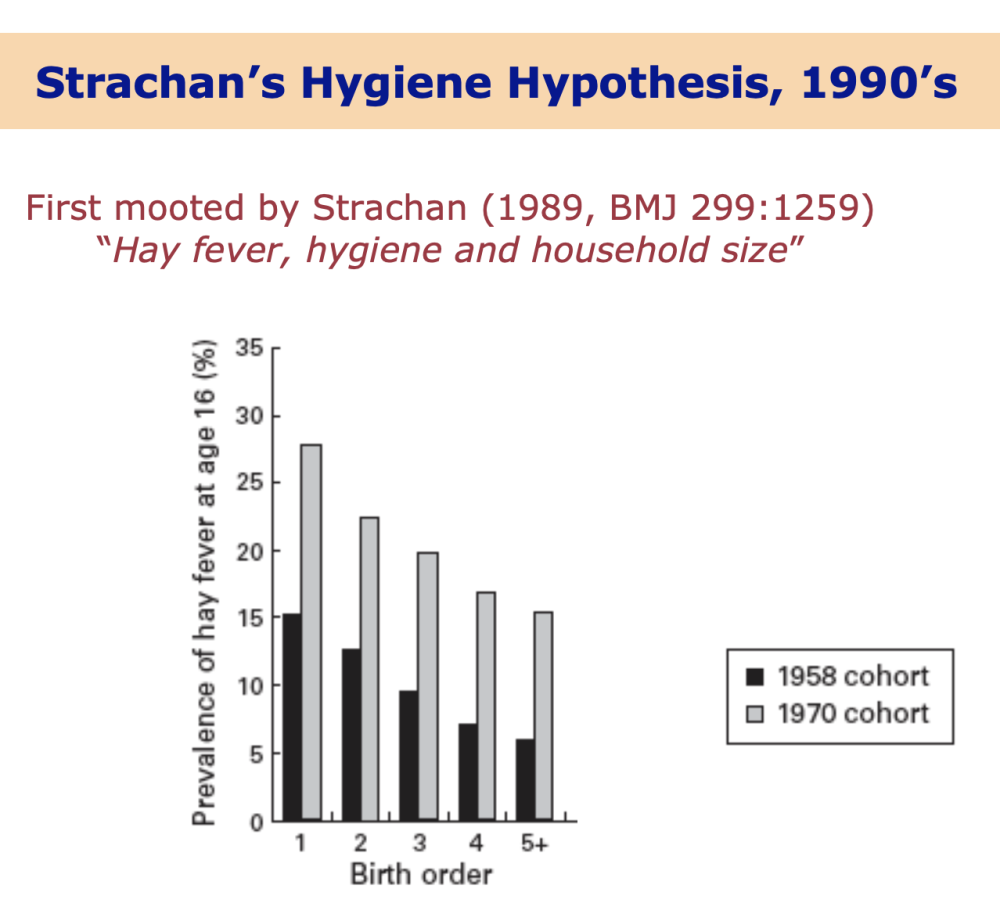
The “Hygiene Hypothesis” owes its origins to David Strachan’s observation that younger children in larger families had more microbial infections but less allergic symptoms, posited to favour viral/bacteria-induced Th1 over allergy-promoting Th2. Various reiterations also discussed whether early life infections imprinted a more moderated level of responsiveness, and/or if infections acquired later in life could ameliorate inflammatory diseases.
Frequently, commentators remarked on the reciprocal global distribution of immune-mediated inflammatory diseases (eg asthma, colitis and multiple sclerosis) in the industrialised countries, and the high prevalence of helminth parasites in the “Global South”. As correlation does not demonstrate causality, intervention studies in humans, and mouse model studies, were required.

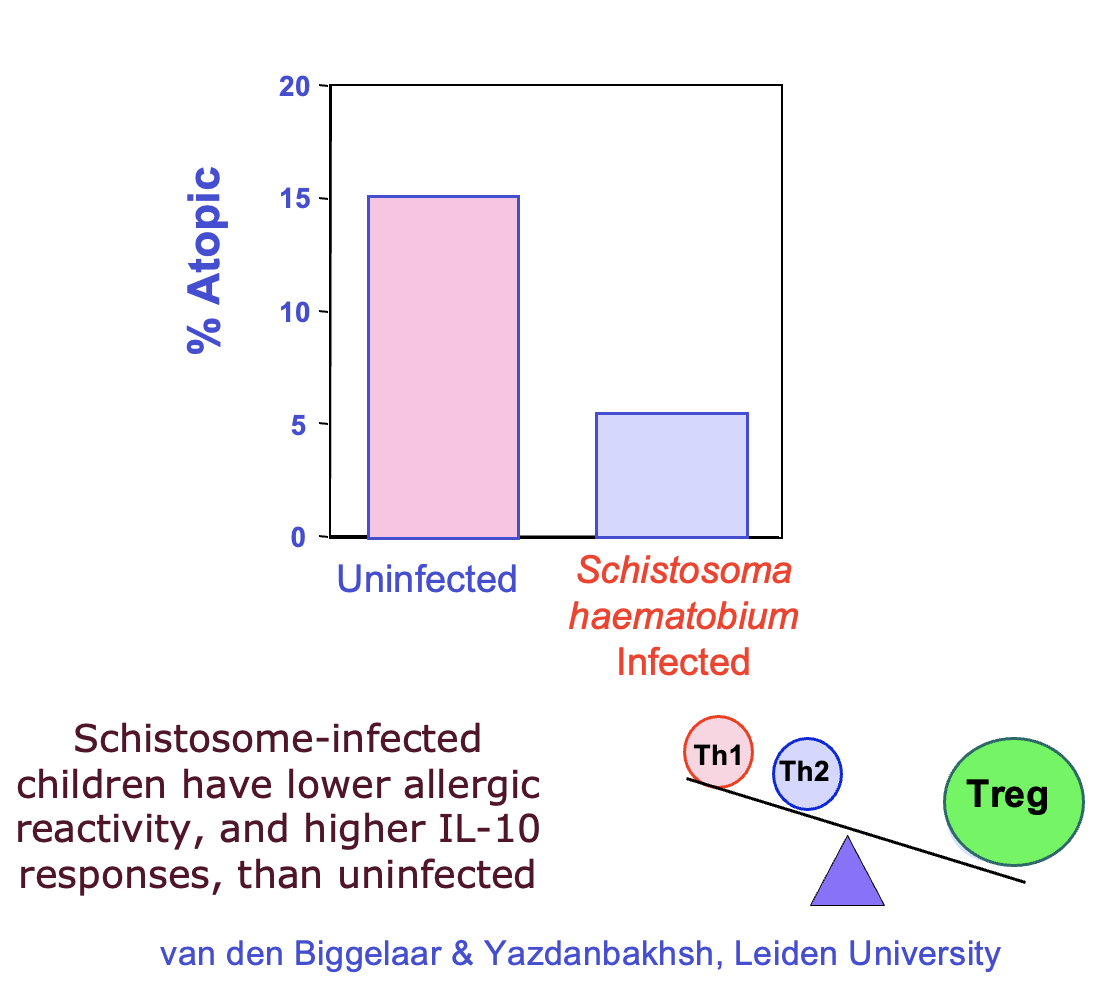
Maria Yadanbakhsh then showed in Gabon that children with Th2-driving Schistosoma infection were also protected against allergy, indicating Treg activity rather than Th1/Th2 antagonism, supported by high IL-10 responses in infected children. Following praziquantel clearance of the schistosomes, more children became allergic than in untreated classmates, the first evidence of a causal link between helminth infection and reduced inflammatory status.
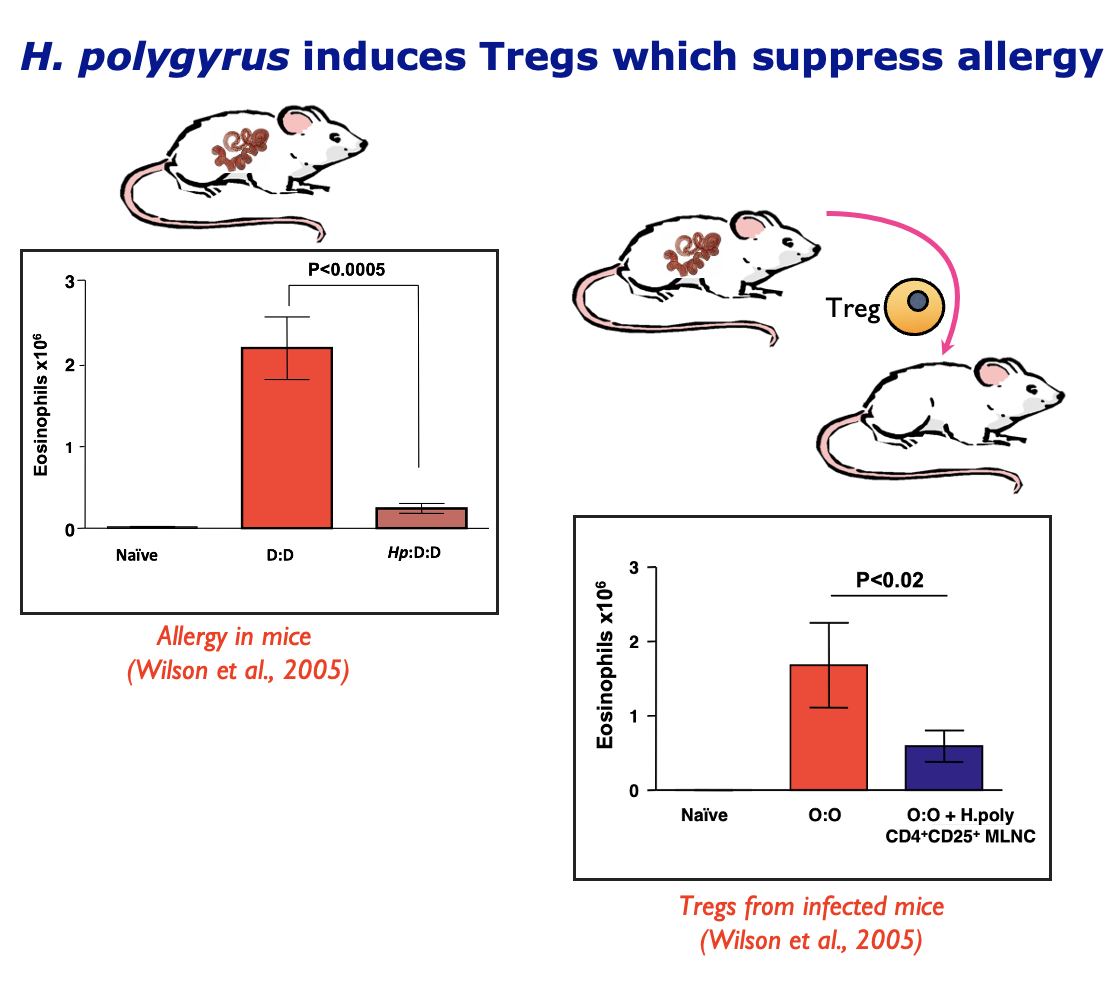
Mark Wilson in the Maizels Lab then tested a mouse model of allergy to house dust mite and ovalbumin: animals infected with Helgmosomoides polygyrus were protected from allergic eosinophilia in the lung. Tregs taken from infected, but nonallergic, mice transferred the protection to uninfected, but allergic recipients. Thus helminth-promoted Tregs suppressed allergic airway inflammation in a defined vignette of the “Hygiene Hypothesis”
Key References
van den Biggelaar, A.H., van Ree, R., Rodrigues, L.C., Lell, B., Deelder, A.M., Kremsner, P.G. and Yazdanbakhsh, M. (2000). Decreased atopy in children infected with Schistosoma haematobium: a role for parasite-induced interleukin-10. Lancet 356(9243): 1723-1727. 10.1016/S0140-6736(00)03206-2. https://www.ncbi.nlm.nih.gov/pubmed/11095260
van den Biggelaar, A.H., Rodrigues, L.C., van Ree, R., van der Zee, J.S., Hoeksma-Kruize, Y.C., Souverijn, J.H., Missinou, M.A., Borrmann, S., Kremsner, P.G. and Yazdanbakhsh, M. (2004). Long-term treatment of intestinal helminths increases mite skin-test reactivity in Gabonese schoolchildren. J Infect Dis 189(5): 892-900. 10.1086/381767. https://www.ncbi.nlm.nih.gov/pubmed/14976607
Wilson, M.S., Taylor, M.D., Balic, A., Finney, C.A., Lamb, J.R. and Maizels, R.M. (2005). Suppression of allergic airway inflammation by helminth-induced regulatory T cells. J Exp Med 202(9): 1199-1212. PMC2213237 10.1084/jem.20042572. https://www.ncbi.nlm.nih.gov/pubmed/16275759
Maizels Lab Reviews
Maizels, R.M., McSorley, H.J. and Smyth, D.J. (2014). Helminths in the hygiene hypothesis – sooner or later ? Clin Exp Immunol 177: 38-46. 10.1111/cei.12353.
Maizels, R.M. (2009). Exploring the immunology of parasitism–from surface antigens to the hygiene hypothesis. Parasitology 136: 1549-1564.
Maizels, R.M. (2005). Infections and allergy – helminths, hygiene and host immune regulation. Curr Opin Immunol 17: 656-661.
Wilson, M.S. and Maizels, R.M. (2006). Regulatory T cells induced by parasites and the modulation of allergic responses. Chem Immunol Allergy 90: 176-195. 10.1159/000088892. https://www.ncbi.nlm.nih.gov/pubmed/16210910
Yazdanbakhsh, M., van den Biggelaar, A. and Maizels, R.M. (2001). Th2 responses without atopy: immunoregulation in chronic helminth infections and reduced allergic disease. Trends Immunol 22(7): 372-377. 10.1016/s1471-4906(01)01958-5. https://www.ncbi.nlm.nih.gov/pubmed/11429321
Publications from Leading Authors
Lambrecht, B.N. and Hammad, H. (2017). The immunology of the allergy epidemic and the hygiene hypothesis. Nat Immunol 18(10): 1076-1083. 10.1038/ni.3829. https://www.ncbi.nlm.nih.gov/pubmed/28926539